Working documentation for the lighting and sound systems in the FAAC Theatre at Bishop McNamara High School in Forestville, Maryland, the venue for the school’s theatre, Classical Dance and Sankofa productions. Dr. George rebuilt the control booth, drafted the repertory light plot and mapped the house sound system as part of running the space.
Control Booth
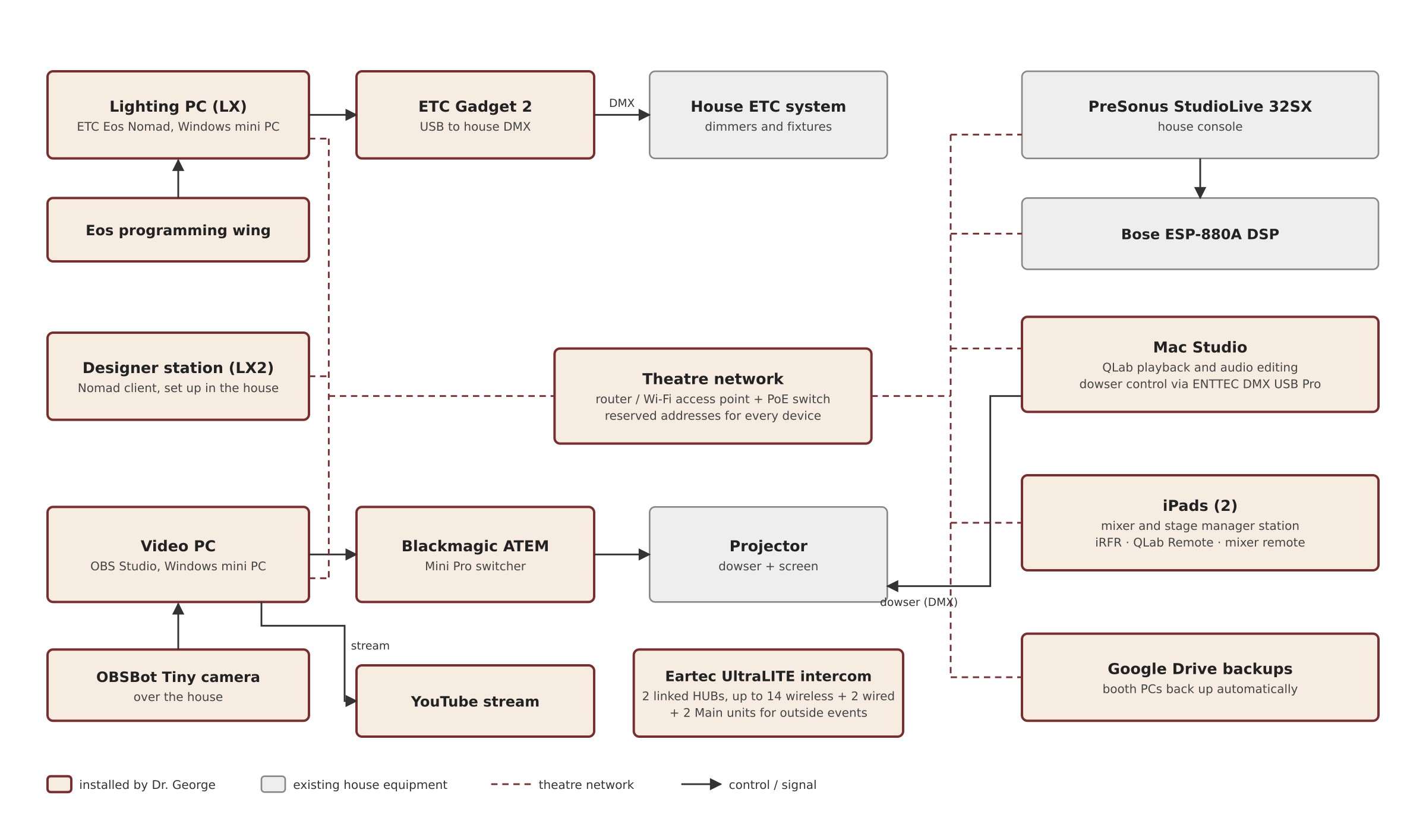
Since 2024 Dr. George has rebuilt the FAAC Theatre control booth around a dedicated theatre network. Apart from the house sound console and processor, the booth’s control systems are his installation:
- Lighting control. A Windows mini PC running ETC Eos Nomad with an Eos programming wing drives the house ETC system through a Gadget 2, with a spare Gadget on hand. A second Nomad station (LX2) sets up in the house as a designer’s remote, linked to the main station over the network.
- Playback and remote mixing. A Mac Studio runs QLab and audio editing, and opens and closes the projector dowser over DMX through an ENTTEC DMX USB Pro. The StudioLive 32SX can be mixed remotely from the iPads, PCs or the Mac.
- Video and streaming. A second mini PC runs OBS Studio with an OBSBot Tiny camera over the house and streams performances to YouTube. A Blackmagic ATEM Mini Pro switches sources to the projector.
- Theatre network. A theatre-only router and Wi-Fi access point with a PoE switch, with a reserved address for every device so the consoles, computers and remote apps find one another. The booth PCs back up automatically to a shared theatre Google Drive.
- Remote control. iPads at the mixer and the stage manager’s station run iRFR, QLab Remote and the mixer remote.
- Intercom. An Eartec UltraLITE wireless intercom, replacing the retired ClearCom system. Two linked HUB units carry two channels and support up to fourteen wireless and two wired headsets. Two more Main units run their own systems of up to three headsets each for events outside the theatre.
Venue Handbook
Dr. George wrote and maintains FAAC Theatre: Information and User Manual, the working handbook for the venue. It gives students, staff and visiting groups one reference for how the space runs:
- The building: an overview of the Fine Arts and Athletic Center and the theatre’s spaces (stage, auditorium, scene shop and loft, control booth and offices), with Wi-Fi coverage.
- House policies: food and drink, equipment use only with the Technical Director’s approval, rigging approval, flameproofing and no flammables on stage, clean-up, seating and aisles, and no helium balloons.
- Production systems: an inventory of every booth computer, console and device, with what each does and where it lives, plus the theatre network, automatic backups and the software in use.
- Intercom: how the Eartec system is configured, with step-by-step pairing for HUB and Main units.
- Lighting: startup and shutdown procedures, and preset cues for rehearsals, work lights, meetings with the screen in, and stage washes in each class’s color, so anyone can bring the room up safely without programming.
- Audio and video: powering the sound system up and down in the right order, setting up the color-coded wireless microphones, and running the projector, dowser, screen and switcher for presentations.
- Event staffing: how Mac Productions, the program’s production staffing arm, crews events with students from the technical theatre courses and with service-hour volunteers.
Access credentials and network details are kept in an internal version and are not published.
Repertory Light Plot
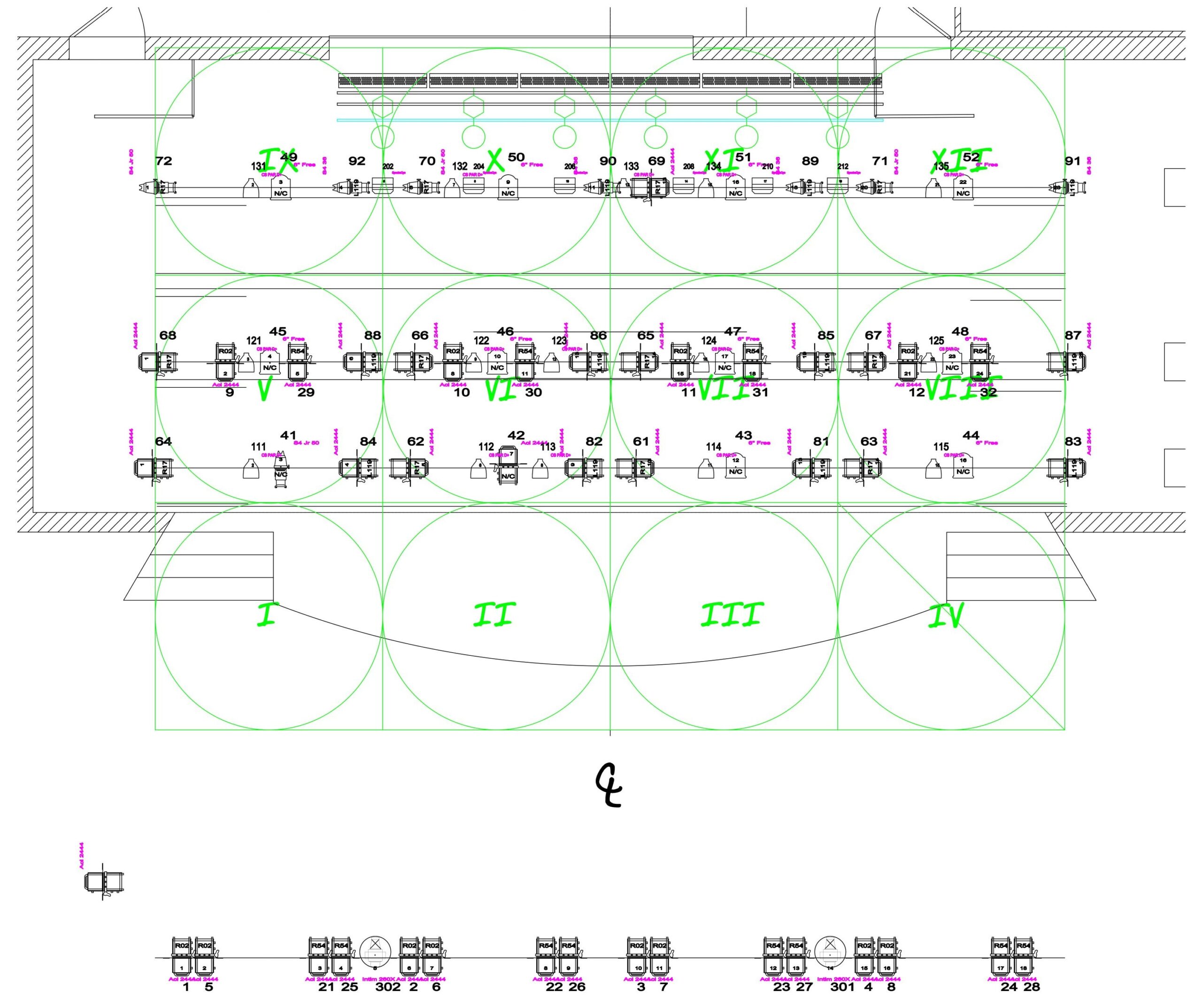
The rep plot covers twelve focus areas. Front light comes from the FOH position, with two Chauvet Intimidator Spot 260X moving lights as specials; three electrics carry high sides, backlight, ColorSource PAR washes and the SpectraCyc cyc lights. Each unit is labeled with its number, channel and color. The plot was drafted in progeCAD and reconciled against the Lightwright paperwork and the Eos magic sheet for Little Shop of Horrors (2026). Click the plot to enlarge it, or download the full-size PDF.
Sound System
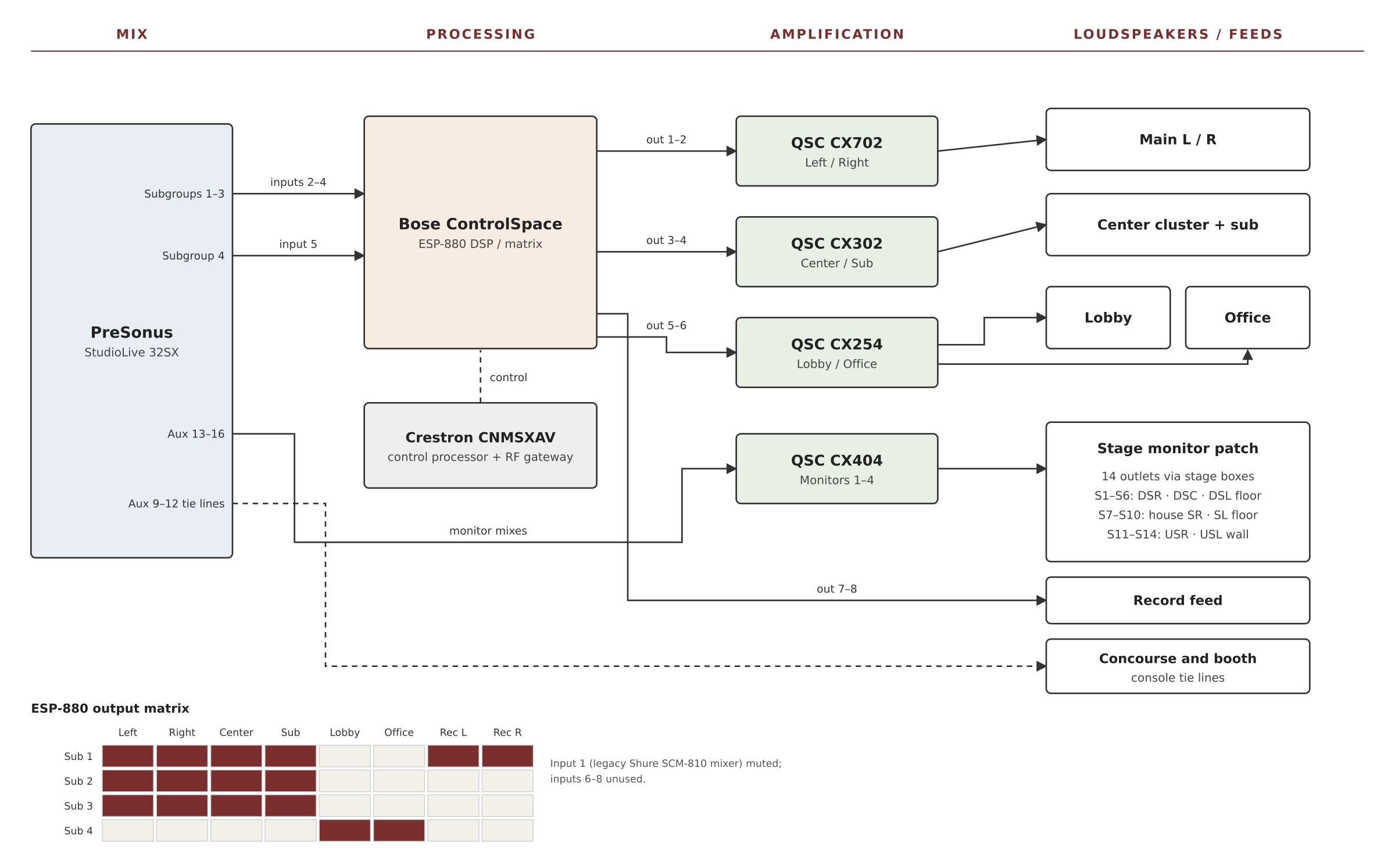
The house system runs from a PreSonus StudioLive 32SX at front of house through a Bose ControlSpace ESP-880 processor. Its output matrix feeds QSC amplifiers for the main left and right, the center cluster and subwoofer, and the lobby and office zones, along with a record feed. Four console aux mixes drive a QSC CX404 for stage monitors, patched to fourteen speaker outlets around the stage and house. A Crestron processor handles system control.
Amplifier Patch
| Amplifier | Feeds | Source |
|---|---|---|
| QSC CX702 | Main left and right | ESP-880 outputs 1–2 |
| QSC CX302 | Center cluster and subwoofer | ESP-880 outputs 3–4 |
| QSC CX254 | Lobby and office | ESP-880 outputs 5–6 |
| QSC CX404 | Stage monitors 1–4 | Console aux 13–16 |
Stage Monitor Outlets
| Outlets | Location |
|---|---|
| S1, S2 | Downstage right, floor |
| S3, S4 | Downstage center, floor |
| S5, S6 | Downstage left, floor |
| S7, S8 | House right, floor |
| S9, S10 | House left, floor |
| S11, S12 | Upstage right, wall |
| S13, S14 | Upstage left, wall |